July 22, 2026

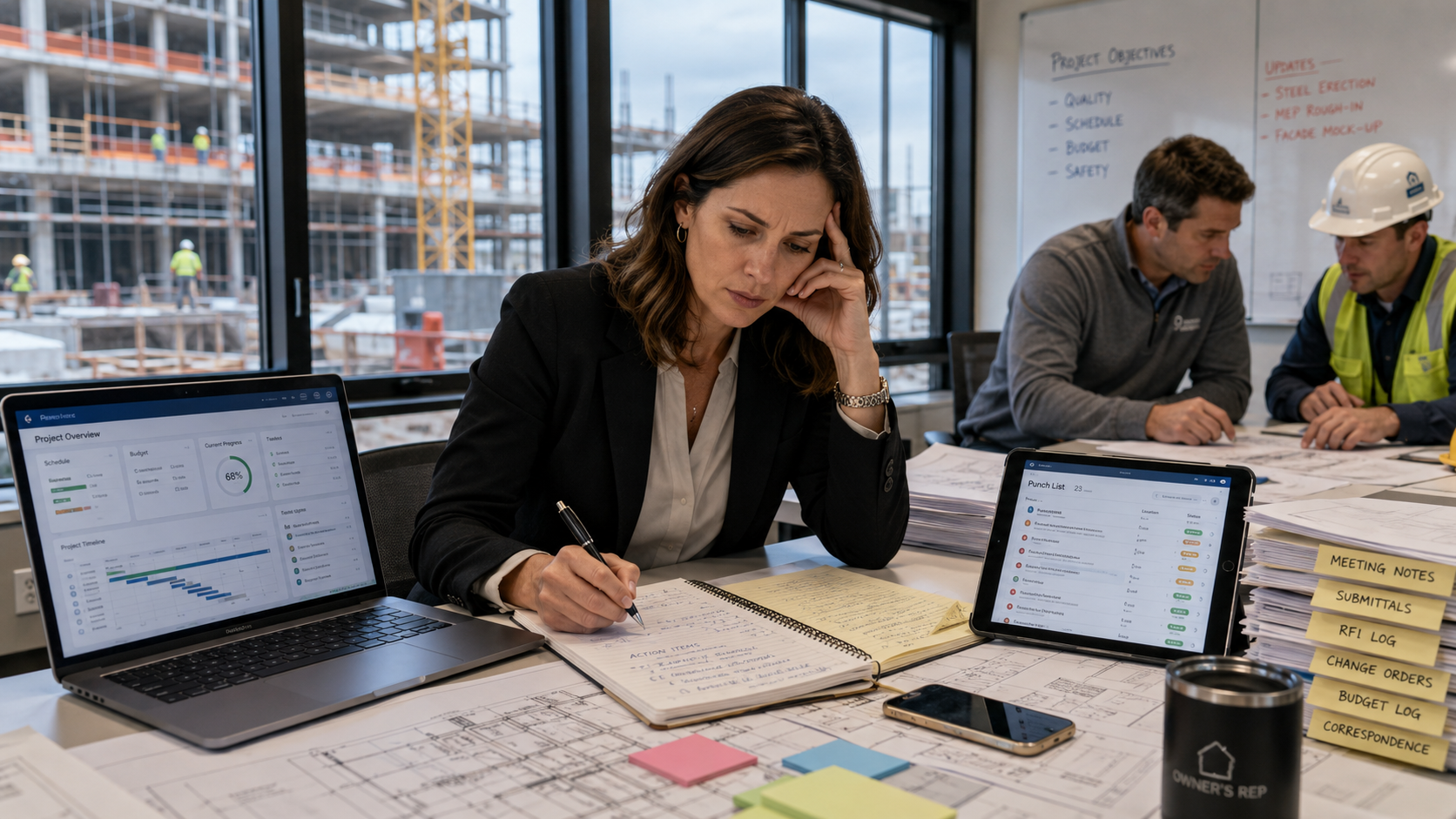
Walk through most construction software available today and a pattern becomes clear: it is built for the people doing the physical work. Scheduling tools for field crews, estimating software for contractors, project management platforms for tracking daily logs and RFIs from the job site up. All of it is useful, and all of it is aimed at the same layer of the industry: the trade side.
Almost none of it is built for the person managing the project on behalf of the money.
The Role That Gets Left Out
Owner's representatives, sometimes called owner's reps or construction managers acting on the owner's behalf, sit in a different position than a GC or a subcontractor. Their job isn't to build anything. Their job is to protect the owner's interests across the entire lifecycle of a project: making sure the budget holds, the bids are fair, the RFIs get answered, and the person who's paying for the project has full visibility into where things stand at any given moment.
That is a fundamentally different job than running a job site, and it requires fundamentally different tools. But because most construction software gets built from the trade side outward, owner's reps are often left stitching together a workflow out of tools that weren't designed with them in mind.
What "Underserved" Actually Looks Like Day to Day
For an owner's rep, this usually doesn't show up as one dramatic gap. It shows up as a dozen small ones that add up over the course of a project.
Bid comparisons happen in spreadsheets because there's no tool built specifically for leveling bids at the ownership level. Budget tracking lives in a separate system from the bidding process, so there's no single place to see how committed costs are trending against the original estimate. RFIs get relayed by email, with the owner's rep manually forwarding questions between the GC and the architect because there's no shared platform that includes both sides.
None of these gaps are insurmountable on their own. But together, they mean an owner's rep spends a meaningful part of their week doing administrative translation work, moving information between systems and people, instead of doing the actual job of protecting the owner's interests.
Why This Gap Exists
It isn't that construction software companies have ignored the ownership side on purpose. It's that the trade side of construction is where most of the volume is, and volume is where most software gets built first. GCs and subs vastly outnumber owner's reps, so it makes sense that the earliest and most mature tools in the space were built to serve them.
The result is that owner's reps have had to adapt trade-focused tools to a job that was never quite what those tools were designed for. Project management platforms built around daily field logs get repurposed for budget tracking. General-purpose spreadsheets and email become the default system of record for bidding and RFIs, simply because nothing built specifically for the ownership layer existed yet.
What the Ownership Layer Actually Needs
The tools an owner's rep needs are not smaller versions of GC tools. They are a different category entirely, built around a different set of priorities:
A single, real-time view of budget versus actuals across every committed cost, not just what's logged after the fact. A way to source and compare bids that doesn't require manually reconciling five different formats. A shared space for RFIs so the owner's rep isn't stuck as the manual relay point between contractor and consultant. Visibility across the entire project, from first budget to final closeout, without having to piece it together from four different systems.
These aren't feature requests so much as they are a description of the job itself. An owner's rep's value comes from having a complete, accurate picture of a project at all times. Software built for that role should make that picture easier to see, not harder to assemble.
Where This Is Headed
Construction technology has spent most of its history building outward from the job site. That made sense when the field was where the volume and the complexity lived. But as projects get more complex and portfolios get larger, the ownership side of the table is facing its own version of that complexity, without tools built specifically to handle it.
The next wave of construction software is starting to move up the stack, toward the people managing the money rather than just the people managing the work. Owner's reps have been underserved for long enough that even modest, purpose-built tools for this layer represent a meaningful shift in how projects get managed from the top down.
This is the gap we built Outbidd to close, with budgeting, bid sourcing, and bid leveling designed specifically for owners and the reps who represent them, rather than adapted from tools meant for someone else's job.
Transform your project with complete bid management & financial oversight
.png)
Budget. Bid. Build.
Get in touch
.svg)
.svg)